Friday, July 2, 2010

Three Planets plus at the Observatory

Last Friday the clouds played hide-and-seek, but the folks at Cline Observatory had some nice views of a globular cluster, the Bay of Rainbows on the Moon, and planets.

Venus was the first "star" to be found by a guest, a game we sometimes play. Venus is so bright and so high in the early evening sky, it is easily the evening star.

Mars was a rusty spot more difficult to discern. The clouds were not kind to us here.

Saturn's ring is slowly increasing it's tilt from our perspective. It was just last year that Saturn experienced "zero degrees inclination." We are now beginning to see more and more of the "northern" side of the rings as Saturn's north pole tilts toward us.

Tuesday, June 15, 2010

Senses

I grew up learning that we humans possessed five senses. Can you quickly name them?
touch
taste
smell
sound
sight

What is a sense? My handy dictionary says, among others,
"a specialized animal function or mechanism (as sight, hearing, smell, taste, or touch) basically involving a stimulus and a sense organ."

I just finished What If the Earth Had Two Moons? by Neil Comins, and he posits an interesting wrinkle to our understanding of senses. Comins writes that two other senses are usually left off the list taught to children, and they are "heat and gravity."

We can put our hand near a fire and feel the heat, but are we using the same sense organs (nerves) we use for touch? Does that make "feeling heat" a part of the sense of touch?

And what sense organs do we use for gravity? To sense when we are falling, do we use another sense organ other than our eyes (seeing the environment pass by) and nerves (feeling the wind, friction and impact)?

What do you think? Seven senses? Or five?

Wednesday, May 26, 2010

Lost in Space


This past Friday evening, Dr. Steve Danford (UUC-G) addressed the Greensboro Astronomy Club regarding the future of America's space program. Steve's always a good presenter, and he can even make sense out of the chaos we call NASA.

He shared a graphic from Dr. Harry Shipman (University of Deleware) that puts the major issues before us and guides us to logical conclusion.

If I read this correctly, if we find that some things are best made in space ("space industrialization") AND we find celestial resources to live independently of Earth ("Extraterrestrial Resources to Support Humans") we will see, sooner or later, full human settlement of outer space, with a thriving space station or two and some colonies on the Moon, Mars, and other locales.

If, on the extreme other hand, we find neither things to make in outer space, nor resources on which to live, we will have a future with robotic explorers and telescopes.

What do you think? Does this approach make sense?

Thursday, May 13, 2010

Turtle in the Road


Coming home from shopping today we encountered a big and dirty Eastern Painted Turtle in our street.

We use to be able to walk to Hester Park from our house, but the addition of Painter Boulevard has cut off not only our path to the park, but the route for animals as well.

I've noticed that the Japanese Beetles have not been eating our Purple Leaf Plum trees like they use to. We're also seeing fewer raccoons and possums.

So where this big turtle was going, and how it was planning to get there, I am at a loss.

We loaded him in the car and drove him to the lake at Hester Park. Boy did he seem happy, although the geese seem to be a little disappointed.

Saturday, May 8, 2010

Beauty of Saturn

One of the most popular sights at the Observatory is the sixth planet from the Sun, Saturn. Friday I had the opportunity to have dinner with a member of the Cassini Mission investigating this beautiful planet and her moons.

Dr. Anne Verbiscer from the University of Virginia shared this wonderful image taken by the space probe in September of 2006. This is the ringed planet back-lit by the Sun. Detected from this work were two new faint rings

You can see more by going to the Cassini Home Page at http://www.ciclops/org/index/php

Thursday, May 6, 2010

Dr. Doolittle


I've been working at the Natural Science Center of Greensboro for almost six years, now. It's been a great experience, and I really enjoy working with the animals.

Many times I'll talk to the animals, as if they can understand what I'm saying. They may be able to pick up the tone of my voice, but I still say nice words to them.

Launa, one of our newer birds, has not been used in any of my programs yet. She's a nice little bird, and I not only talk to her, but I sing. Sometimes Launa talks back and sings with me. She'll often sit on my hand and nibble on my watch.

Sunday, April 25, 2010

65 is sick


About 16 years ago, Barbara brought home a little kitten found at the pound. I really wasn't interested in having a cat, but she was a beautiful kitten.

The flea collar she was wearing had the number 65 handwritten on it, and I thought that maybe that indicated her place in line for a trip to the door at the end of the hall. I 'd never had a pet with a number as a name, so the kitten was named 65.

Our dalmatians thought she was a toy for them to play with. Some rather traumatic incidents made 65 shy and reserved. Until out last dog died, 65 was more or less invisible around the house.

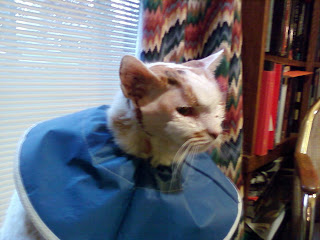
Last November she had a polyp removed from her right ear, and when she came home she acted like a different cat. She followed us around, she meowed at us, she sat on our laps, she was very different. (The picture above is with a soft collar to keep her from scratching at her stitches.)

Last Wednesday she had a seizure in the living room. The earliest vet appointment was for Saturday morning. On Thursday she had another seizure, scratching and biting Barbara's foot.

Yesterday morning the vet took some blood and did some tests. We'll have to wait until Monday or Tuesday for the results. 65 does not appear to be in any pain. Barbara and I are probably more uncomfortable during the seizures than the cat is.

Sixteen years with an animal can help a bond develop.